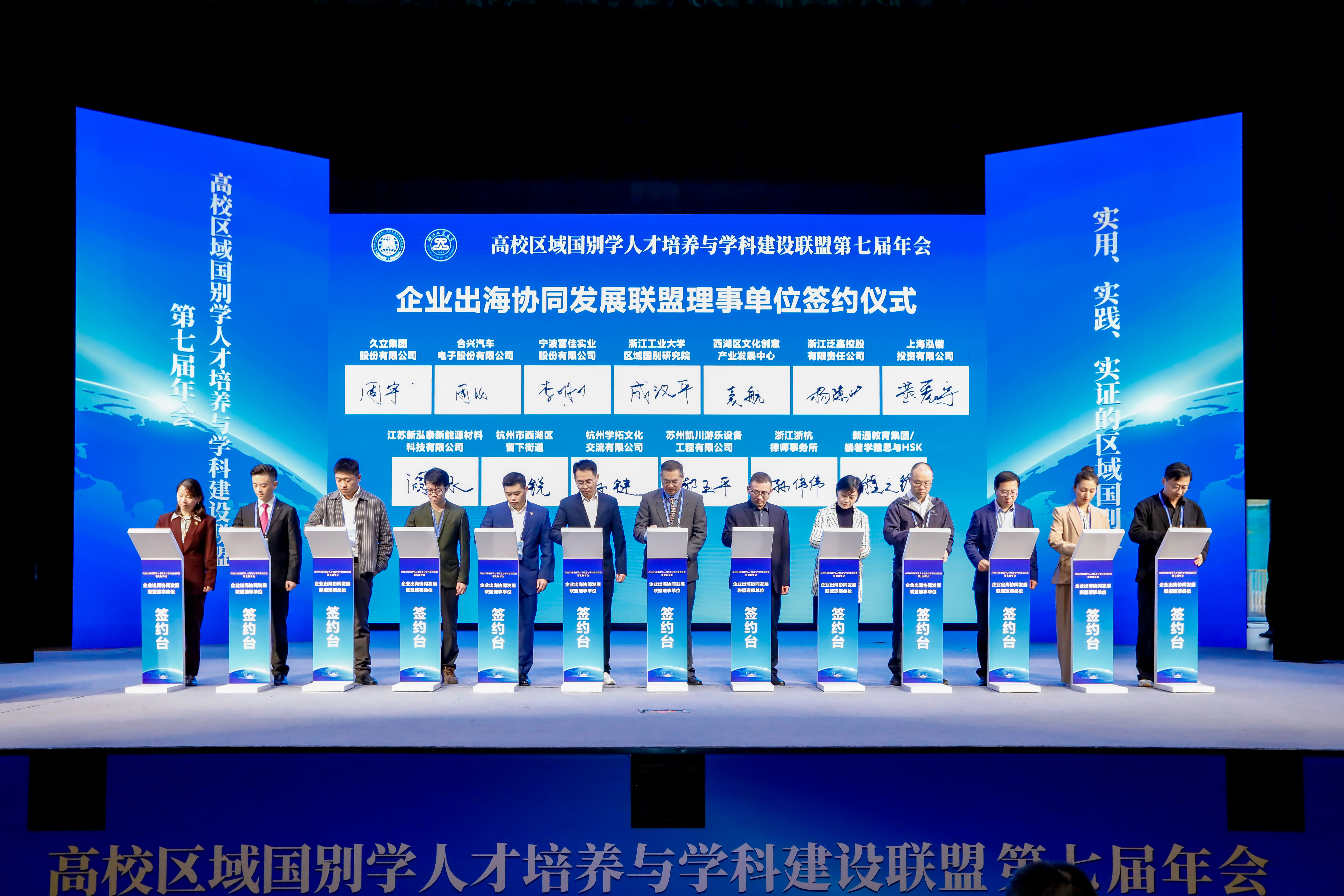
On November 1, at the 7th Annual Conference of the National Alliance for Talent Training and Discipline Construction of Regional and Country Studies in Universities (referred to as the "Alliance" for short), Fanjia signed a strategic cooperation agreement with the Institute of Regional and Country Studies (ASEAN Research Center) of Zhejiang University of Technology. Yang Yinfeng, founder and chairman of Fanjia, was appointed as a Distinguished Research Fellow of the Institute.The two sides will carry out long-term cooperation in areas including enterprise global expansion, ASEAN investment, project research and talent training, pushing the progress of regional and country studies to a new level and jointly supporting high-quality global expansion of Chinese enterprises.
The Institute of Regional and Country Studies (ASEAN Research Center) of Zhejiang University of Technology focuses its research on the 10 ASEAN countries. Closely aligning with the major strategic needs of the state and Zhejiang Province, its distinctive and outstanding research achievements directly serve enterprise global expansion and the formulation of international trade rules. It is committed to providing high-end talent and intellectual support for Zhejiang's high-level opening-up and the innovative and high-quality development of enterprises.As one of the first batch of provincial-level regional and country research centers in Zhejiang Province, the Institute (Center) has led 29 national-level research projects, deeply promotes collaborative innovation among government, industry, universities and research institutes, and has long provided decision-making support for departments including the General Office of the Provincial Party Committee and the Publicity Department of the Provincial Party Committee.
As an innovative representative enterprise in the enterprise service sector, Fanjia provides one-stop diversified services including global business travel, administrative management and digital intelligent payment for over 10,000 listed and medium-to-large enterprises. It has accumulated profound experience in services such as cost optimization, compliance management and operational efficiency improvement for enterprises expanding globally.With the conclusion of this strategic cooperation, Fanjia becomes a council member of the Enterprise Global Expansion Collaborative Development Alliance. It will provide research funds, theoretical materials, resource support and practical data cases for regional and country studies, build a bridge connecting enterprise demands and regional and country knowledge services, and promote the pragmatic, efficient and high-quality development of regional and country studies.

This annual conference of the Alliance gathered nearly 800 experts, scholars and entrepreneur representatives from over 250 universities, research institutions and enterprises across the country, who jointly discussed core issues of talent training and discipline construction in regional and country studies.At the roundtable forum themed Regional and Country Studies Empower Enterprise Global Expansion — From "Going Global" to "Taking Root Globally", Yang Yinfeng held in-depth discussions with experts and scholars including Wei Shizhen (President of Guangxi Minzu University and Dean of the ASEAN College) and Hu Kaibao (Assistant to the President of Shanghai International Studies University and Changjiang Scholar Distinguished Professor of the Ministry of Education). The discussions focused on operational challenges faced by enterprises in the process of global expansion and the practical application of regional and country studies research.

Against the backdrop of turbulent global changes, the external environment faced by Chinese enterprises going global is undergoing profound and complex shifts. The cooperation model between enterprises and academia will further enrich, develop and improve regional and country studies research, deliver more precise and comprehensive support for Chinese enterprises' overseas development, and help Chinese enterprises advance from "going global" to "taking root globally" to achieve high-level international development.